Meta Ads MCP Servers Evaluated Through a Comment and Engagement Data Lens
Only some Meta Ads MCP servers can read comments, and that gap shapes creative diagnosis.

Meta Ads MCP servers connect an AI assistant to Meta advertising tools, but access to campaigns does not always include access to comments. Meta’s official server works well for reporting and campaign execution, while byadsco adds comments, video analysis, and context for the creative. GoMarble and Helena serve broader campaign workflows. For creative diagnosis, the strongest configuration combines campaign execution with comment and competitor intelligence in the same agent context.
Why comment and engagement data is the diagnostic layer that performance teams depend on most
A campaign can hold a stable cost per acquisition while its comment section fills with skepticism or brand confusion. Conversion metrics show whether the campaign is producing results, but they cannot fully explain how people receive the creative. Comments expose objections, sentiment, and social proof. Engagement signals can also reveal fatigue that deserves attention before the next creative brief. For performance teams diagnosing creative resonance, this is evidence.
That distinction becomes sharper when advertisers produce dozens of variants per month. Retrieving comments manually for each ad separates the audience’s response from the process that produces the next batch. Feeding those signals into briefing instead gives creative teams a basis for addressing objections and testing new angles. The useful comparison is therefore not simply which server has the most tools. It is which server puts the right diagnostic evidence into a form an AI agent can use.
What Meta's official Ads MCP server exposes — and what it deliberately leaves out
Meta’s official Ads MCP server, remote-hosted at mcp.facebook.com/ads, has tools for much of the work of running campaigns. Its seven tool categories are comprehensive reporting, ad creation and management, catalog creation and management, signals and datasets, help and troubleshooting, A/B tests and conversion lift studies, and activity logs. That is broad campaign coverage. Reporting has performance metrics, attribution modeling, and daily trends, and the signals and datasets tools show the health of the pixel and Conversion API. For teams focused on conversion efficiency, these tools address much of the daily work.
The gap is in what those categories mean. “Signals” does not mean audience sentiment, and reporting does not expose ad comment threads or reaction counts. The official Ads MCP tools also leave out Instagram organic posting, comments, and DMs. An agent can have access to campaign performance without access to the audience responses that would help explain it.
Meta also puts controls around campaign changes. New objects made through the server start paused, so a human must activate them. After Meta added draft mode on October 6, 2026, edits to existing campaigns, including budget changes, are staged as Ads Manager drafts and only go live once published. Since July 16, 2026, business admins can also block specific actions and cap budgets at the server level. These controls support its role as an operational connector, but they do not add engagement evidence.
The server is also stateless, with no memory between sessions or continuous monitoring between prompts. Its dependence on prompts to watch performance and respond to changes is a separate limitation from the missing comment tools. A team may have all it needs for reporting and campaign management but still need another layer for creative diagnosis.
How the byadsco community server extends the tool surface to include comments, video, and ad dossiers
The byadsco community server covers comments, leads, and pixels as well as campaign management, insights, and audiences. Comment access is the clearest difference from the official option. It brings audience responses into the available tool surface rather than leaving them outside the campaign workflow. That makes the server more useful when the question is why a creative resonates.
Version 4.0.0 adds tools that deepen the creative context. These include a hardened video pipeline through ads_get_video_media, Ad Library media retrieval, server-side video analysis via Gemini through ads_analyze_video, and a one-call ad dossier through ads_get_ad_dossier. The dossier is especially relevant to diagnosis. It pulls creative-level context in a single call, while the comment and video tools supply other parts of the evidence. Comment retrieval, however, should not be confused with a complete sentiment-analysis workflow.
The server is for agencies that manage many clients’ ad accounts from one AI assistant. Its multi-tenant design includes OAuth login, encrypted-at-rest tokens, rate-limit compliance, and circuit breakers. It is built to run as infrastructure. Stateless Streamable HTTP transport, a Docker image, and a GitHub Actions workflow for Cloud Run deployment support that model. The tradeoff is a self-hosted or agency-hosted deployment requirement that the official remote-hosted server avoids.
Version 4.0.0, released September 18, 2026, requires Node.js 22.13+ and generates tool schemas through Zod 4. Tool names, parameters, authentication, and transports are unchanged from prior versions. An agency with technical staff can weigh what it takes to deploy the server against the added tools for diagnosis. For a team seeking minimal setup, the hosting requirement may outweigh the benefit of richer creative access.
How the GoMarble and Helena MCP options handle creative analytics and marketing-loop coverage
GoMarble’s server has tools to create and retrieve ad creative, set up A/B testing, and analyze how the creative performs. Retrieval extracts creative elements such as images, videos, and text. Audience management and enterprise authentication broaden its campaign coverage, while a one-click installer at gomarble.ai/mcp reduces setup friction. Creative analysis is clearly in scope. Comment-level engagement, however, is not documented as a tool, so its diagnostic coverage is performance-metric-based.
They are write depth, safety controls, setup friction, pricing clarity, and marketing-loop coverage, with the last weighted most heavily at ×3. Marketing-loop coverage concerns running work across channels with shared brand context, which can be more useful to a cross-channel team than retrieving individual ad conversations. Helena has a published monthly price and a three-day free trial, and GoMarble also publishes monthly prices.
Neither option documents a comment-thread tool. Both fit performance reporting and campaign execution better than social-signal extraction, but that is not a reason to dismiss them. Their fit depends on the job. A team optimizing work across channels should weight marketing-loop coverage against its own needs, rather than treat comments as the deciding factor by default.
What GetCrux and AdSpy add when comment and engagement intelligence is the primary goal
GetCrux and AdSpy belong to a different tool class from campaign execution servers. Their value is market-wide and competitor intelligence, rather than only operating on an advertiser’s own account. AdSpy provides a searchable database of Facebook and Instagram ads. GetCrux analyzes comments, reviews, organic content, and competitor ad messaging to surface objections, sentiment, testimonials, and creative angles for paid media testing. That is broader diagnostic work than the native comment tools documented for the MCP servers compared here.
Its reported outcome for Cloaked includes substantially more creatives per month, much faster creative batch turnaround, and lower cost per acquisition. The distinction is important for tool selection. A server that retrieves a thread gives an agent evidence, while an intelligence tool built for the job can bring a wider range of evidence together to answer questions about the creative.
This does not make intelligence tools substitutes for MCP servers. The layers answer different questions. Account-level tools help with reporting and campaign changes, while market-wide intelligence helps find objections and angles outside the advertiser’s own campaigns. Even byadsco’s Ad Library media retrieval should not be treated as equivalent to that wider analysis. Access to creative media and analysis of market engagement are different capabilities.
The useful convergence in 2026 is the ability to bring research and execution into one agent workflow. That requires the intelligence tool to be MCP-callable or to feed its output into the same context window. A platform combining competitor ad tracking, creative analytics, and campaign execution can remove manual handoffs between those layers. Unified context is the practical benefit. Without it, adding more tools does not by itself connect an engagement signal to a creative brief and then to campaign execution.
The ban-risk and governance questions that change how safely you can automate engagement-based decisions
Account risk becomes more consequential when an agent can act on its diagnosis. Ban reports are concentrated around unofficial third-party servers, over-scoped tokens, and unattended autonomous agents rather than the official connector used as documented. The most reports came from third-party servers used without OAuth or with pasted System User tokens. Community wrappers vary in authentication patterns, so “third-party MCP” is not a single risk profile.
Rate-limit violations and undisclosed AI content are also active ban vectors independent of the chosen server. Connector choice cannot remove every account risk. The byadsco server’s circuit breaker halts calls on an abuse signal or repeated throttles, providing a mitigation the official server does not offer natively. That control is relevant when agents run engagement-triggered workflows at volume.
The official server’s action blocks and budget caps address a different problem. They limit the reach of an agent that misreads an engagement signal, while paused new objects and draft edits keep campaign changes behind activation or publication. These are meaningful safeguards. They separate a proposed response from a live change. Scoped OAuth and the available action and budget controls should be the default for write access.
Statelessness adds a governance problem as well as a technical one. An MCP connection does not continuously watch sentiment or remember prior sessions, so a response such as pausing a creative when comments turn negative needs an external trigger layer. That layer creates the occasion for the agent to act. The configuration therefore needs both a source of engagement evidence and controls over the actions it can prompt. Neither requirement is a reason to avoid MCP, but neither is supplied merely by connecting an account.
How do you connect your Meta advertising account to an AI assistant using MCP for your engagement workflow?
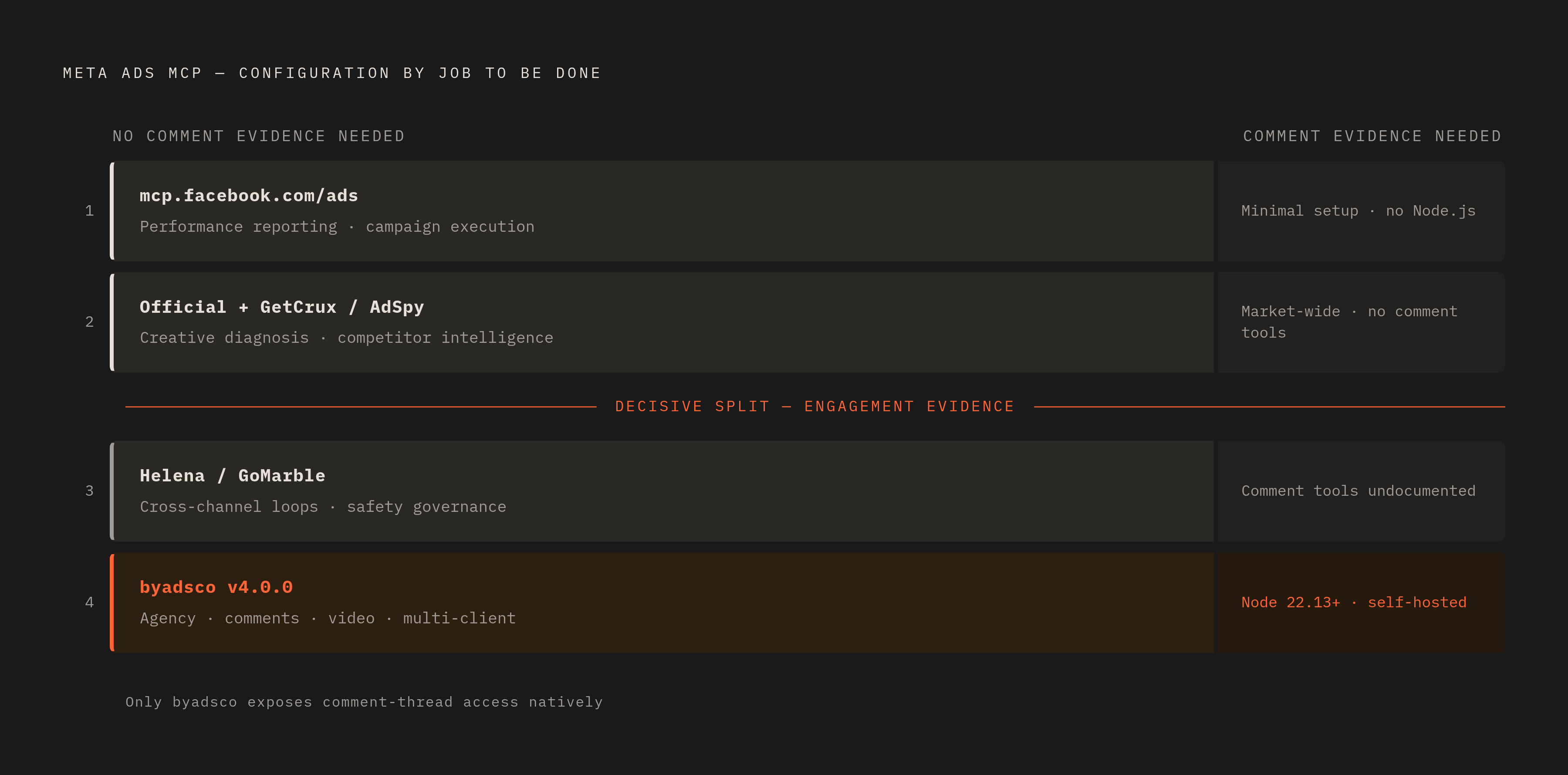
The choice depends on whether engagement data will help with creative briefing, trigger campaign action, or provide competitive intelligence. Those jobs need different combinations of tools. For performance reporting and campaign execution with minimal setup, the official server is the baseline choice. The connection path is mcp.facebook.com/ads through Claude, ChatGPT, or Perplexity, using scoped OAuth. Engagement evidence must come from outside that layer.
For agencies that manage multiple client accounts, byadsco is a better fit when they need access to comments and video creative data as part of running campaigns. The deployment cost is explicit. Version 4.0.0 requires Node.js 22.13+ and a hosted setup, so the choice includes responsibility for infrastructure.
For teams prioritizing cross-channel work and safety governance over raw engagement access, Helena or GoMarble may be more suitable. Helena offers a published monthly price and a three-day free trial, while GoMarble provides a one-click installer and published monthly pricing. Neither supplies documented comment-thread access. Those teams should therefore choose them for their campaign and marketing-loop strengths, with any needed comment evidence supplied separately.
For market-wide creative diagnosis, GetCrux or AdSpy belongs beside an execution server. The configuration that closes the broadest diagnostic gaps without a custom engineering project combines the official server, a comment or competitor intelligence tool feeding the same agent context, and a unified platform layer connecting performance to cross-channel briefing. The deciding test is whether the agent can use the evidence behind a creative decision.
Every new piece from Comment Section Ads, as it's published.
Follow