How Meta Ads MCP Connects AI Agents to Your Ad Account
Meta's hosted connector gives AI agents 29 tools, but humans still approve launches.
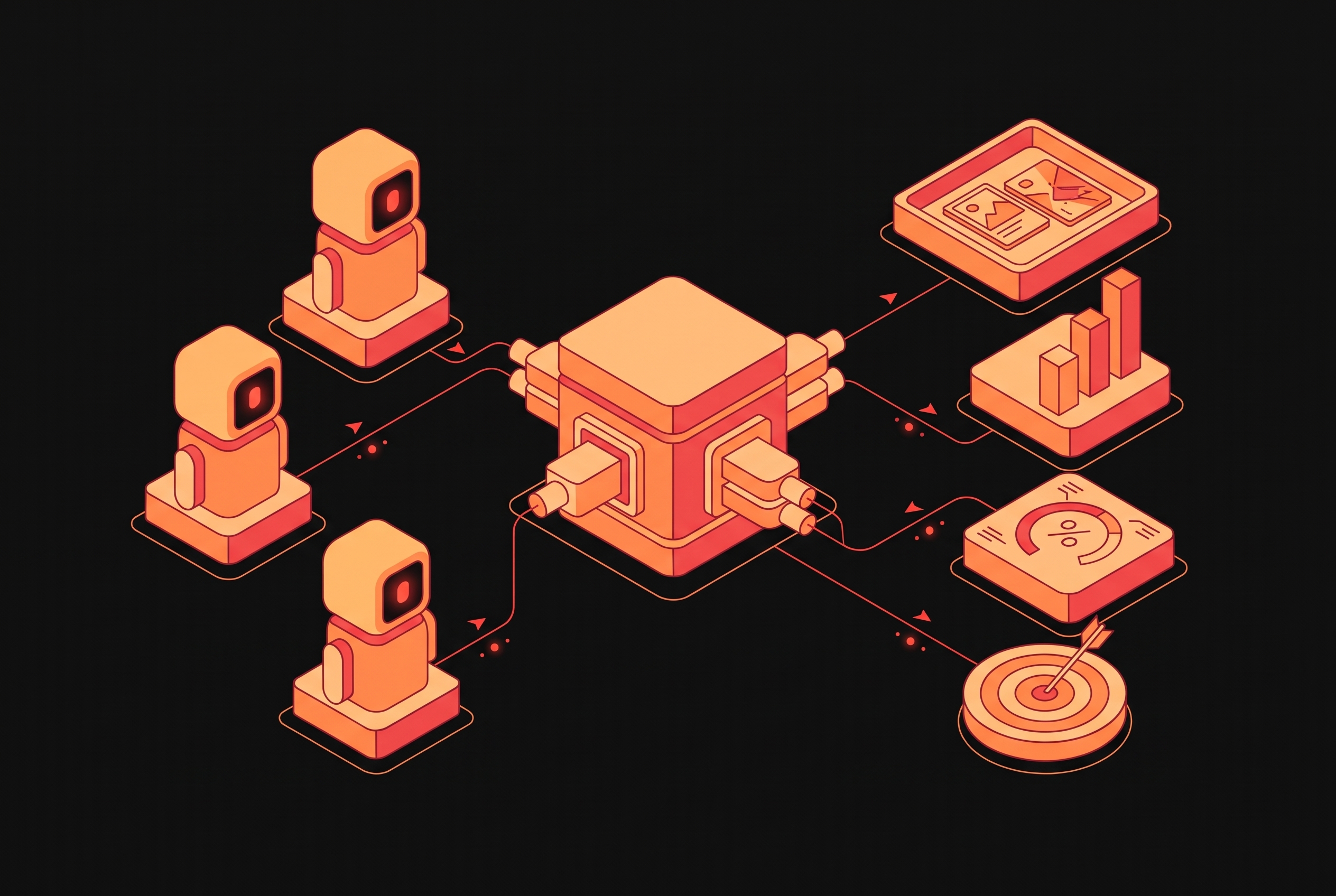
Meta Ads MCP is a connection hosted by Meta that lets MCP-compatible AI assistants use 29 permission-scoped tools to manage ads on Facebook and the photo-sharing platform. It turns an agent into an authorized ad-account operator through OAuth. The shift is from clicking through an interface to asking for work in conversation, but permission to act is not a substitute for human approval.
What is Meta Ads MCP, and what changed when Meta launched it?
The Meta Ads MCP server sits between an AI assistant and Meta’s advertising systems. Meta hosts it remotely as part of its ads AI connectors family, which opens Meta business surfaces to third-party AI clients through structured tools. MCP stands for Model Context Protocol. For a non-developer, the assistant can call defined tools to work on the account instead of just explaining which buttons an advertiser should click.
That placement changes who can operate the account. The Marketing API is an integration surface for developers who write code, while the MCP server is a tool-calling surface for agents responding to natural language. The underlying advertising data is the same. What changes is the caller and the route from a person’s request to an account operation. An advertiser can ask a question in an AI client, and the agent can use the tools to retrieve the account data needed to answer it.
The older integration path required registering a developer app and waiting through App Review, while OAuth through the MCP server reduces that process to minutes. Access still has a gate. The advertiser authorizes the connection, and the available tools operate within permission scopes. Meta has therefore made the agent a sanctioned operator of the account.
The 29 tools the server exposes and what read-write access means in practice
Meta documents 29 tools across seven categories. Those categories cover much more than campaign creation, and the large majority of the toolset sits in reporting, catalog operations, and diagnostics, with campaign writes accounting for a smaller share. The balance is worth noticing before granting access. This is primarily a way for an agent to read and diagnose an account, with selective powers to change it. “Read-write” does not mean every part of the advertising system is open to manipulation.
Meta labels the first category “Comprehensive reporting,” covering detailed performance data and campaign insights. “Ad creation and management” covers creating and editing ads, ad sets, and campaigns. The next category reaches into product operations. “Catalog creation and management” covers creating catalogs, adding product data, and troubleshooting data feed and item visibility issues. “Signals and datasets” covers signal health and quality, including work to prioritize investment in signals setup.
“Help and troubleshooting” lets the agent search Meta Business Help Center articles relevant to a query. “A/B tests and conversion lift studies” covers creating and managing those tests and studies, as well as retrieving details on existing ones. History is available as a separate category. “Activity logs” exposes ad-account changes in a way that mirrors the Ads Manager campaign history page, giving the agent a route to investigate changes alongside current performance.
Meta specifies the most important creation safeguard plainly. Every campaign, ad set, or ad created through the MCP server starts paused. Nothing goes live until a human activates it in Ads Manager. That creates a review point between generating a campaign structure and spending money on it. It is a creation default, however, with approval workflows for other write actions left unspecified.
The tools also have firm visibility limits. They expose headlines, primary text, and descriptions, but not the image or video assets themselves. Creative-fatigue analysis is therefore incomplete through this connection alone. The agent also has no access to the auction internals, including automated campaign optimization, bidding algorithm mechanics, and audience-expansion logic. The agent can operate the campaign’s structure without gaining access to the machinery that determines how the auction behaves.
The two connection surfaces — MCP server and CLI — and the one gotcha that can spend real money
Meta’s ads AI connectors have two routes into an account for people who work in different ways. The MCP server is the conversational, browser-accessible route for compatible assistants, including Claude and ChatGPT. It uses OAuth through the familiar Facebook Login dialog. For an advertiser who wants to manage campaigns through chat rather than code, this is the relevant surface.
The connection starts in an MCP-compatible client, and OAuth grants access to the account. Anthropic’s help center states that remote MCP custom connectors are available on all Claude plans, including Free, with Free users limited to one custom connector. Free access therefore has a practical restriction. Another MCP-compatible client may make users pay for a plan with the same access. The client’s connector support and plan limits are separate from the permissions granted to the Meta account.
The CLI is a different working environment. It is a local command-line tool used by agentic coding tools such as Claude Code or Codex, and it authenticates with a system-user token rather than OAuth. Its intended use is programmatic, pipeline-style work by developers building AI-native advertising workflows. The distinction is not just where someone types. It also changes the default state of what the agent creates.
Through the MCP server, newly created campaigns, ad sets, and ads start paused. When an agent uses the CLI with a real ad account, the campaigns it creates are live and spending unless the operator sets their state. That difference can spend real money immediately. It is designed behavior for the developer surface. A team choosing a connection needs to check which surface the agent uses before assuming that a human will get to review a campaign before it goes live.
What conversation-driven ad management actually replaces — and what it does not
A paid social team can answer a question about its account through live API queries with sub-minute data freshness, replacing manual reporting through static CSV exports, pivot tables, and multi-tab dashboards. The question no longer needs a reporting project. A person can ask for the relevant account information in conversation instead of first assembling the view in which to inspect it. That is a genuine operational change, even when the underlying data has not changed.
Pixel health checks, feed error audits, signal quality reviews, and campaign history lookups no longer have to begin with finding the right screen in Ads Manager. Repetitive campaign structure work can also move into the agent’s tool calls. Scale makes that benefit easier to see. Teams with large numbers of ad sets have more recurring operational work for the agent to handle alongside occasional report requests.
People still have to decide which performance problem to work on and which proposed change fits the business. People still have to set the creative direction, too, because of the visual blind spot described above.
Memory creates a separate limit on the conversational experience. MCP conversations are ephemeral, so the agent does not remember work from a previous session. A request to apply the rules established “last Tuesday” requires the human to supply that context again. Familiar language can hide that missing continuity. The interface feels like an ongoing working relationship, but the connection itself does not preserve the decisions on which the next session depends.
MCP can handle insights and diagnostics freely, where reads are cheap and reversible, while budget changes, pauses, and launches remain subject to explicit human approval. That preserves the main time-saving benefit of conversation-driven work. It also keeps the decision to change the account with someone who can judge the business context alongside the result of the latest query.
Where autonomous execution breaks down — hallucination, learning-phase resets, and missing guardrails
AI models can state numbers that do not match what the API returned. An ambiguous time window, metric definition, or entity filter can lead a model to generate a plausible answer without asking for clarification. A hallucinated result can read just like a verified one, even though the agent has a real connection to the account.
With write access, that reporting error can become an account error. An incorrect interpretation can lead to a wrong budget change, a pause applied to the wrong campaign, or a campaign created with unsuitable settings. The agent can turn its conclusion into an operation against a live advertising account. That is why evaluating the answer and authorizing the action need to remain distinct decisions.
Learning-phase resets create another route to damage. An agent with write access and no rate-of-change constraint can trigger repeated resets without human oversight. Speed can make this problem worse. A system that can make changes quickly also needs a constraint on how often it makes them.
The MCP server does not supply budget caps, approval workflows, or fraud detection. The people who use the server have to add those protections around the access it gives them. Without broader safeguards, the risk includes overspending, account policy violations, and structural changes that are difficult to reverse. An authorized connection establishes the agent’s permission to access the account, while the soundness of a particular action requires separate judgment.
The practical response is a hard division between reads and writes. Under the practitioner operating model described in the brief, the AI proposes a change with the supporting data attached, and a named human approves it before execution. Diagnostics can still run without that write-stage interruption. Budget changes, pauses, and launches cannot. The strategist decides, while budget caps, approval workflows, and rate-of-change limits constrain what the system can do after a decision is made.
How the broader platform landscape is moving — TikTok, X, and what Google’s constraint reveals
TikTok announced its own MCP server in May 2026 and plans to make it generally available in late June 2026. That places Meta’s move within a broader opening of advertising systems to AI agents. The pattern extends beyond a chat feature. Platforms are exposing operating surfaces so advertisers can work through AI tools they already use, rather than learn a separate interface for every channel. These details show where platforms are heading, but do not show that they all let agents do the same things.
Google Ads MCP is still read-only. An agent can use that connection to retrieve information but needs a different path to perform writes. The split complicates a shared operating model. A team seeking conversational execution across channels must use a different path for writes on platforms that do not permit changes through MCP. The extra connection work reintroduces part of the fragmentation a common protocol is meant to reduce.
PaidSync.ai connects Claude, ChatGPT, Gemini, and other AI assistants to numerous platforms with hundreds of tools. Its breadth shows that multi-channel connectors are already proliferating. Tool count is not the whole architecture. More connections do not, by themselves, preserve brand guidelines, historical performance patterns, or market positioning between ephemeral conversations.
A production-grade stack needs that context as well as operational controls. Budget caps, approval workflows, and rate-of-change limits need to be built into the system as controls that apply across campaigns. Reads and diagnostics can remain automated. Human approval belongs at the write layer, where an interpretation becomes a change to the account. This gives the same operating principle a place across channels, even when each platform exposes different capabilities.
The convergence is toward the AI agent as the control surface. Read-only or closed connections limit how much of that work can move into a shared interface, while broader access makes cross-channel execution possible. Conversation-driven paid media becomes durable when a team’s stack combines channel connections with persistent context and controlled writes, rather than treating one more connector as the answer.
Every new piece from Comment Section Ads, as it's published.
Follow