Meta Ads MCP Servers That React to Comment Section Sentiment When Optimizing Campaigns
Meta's official ad server can act on comment sentiment, but only with guardrails.

Meta Ads MCP gives AI assistants permission to read and write to social media ad accounts through Meta’s official remote-hosted server. It can turn comment sentiment into campaign action, but it cannot read comments itself. The model pairs a sentiment feed from another tool with an agent that can pause ads or flag tired creative, while placing tighter limits on changes to budgets and campaign structure.
What is Meta Ads MCP, and what can it do for Facebook and Instagram campaigns?
Meta’s Ads MCP Server documentation describes seven tool categories, including comprehensive reporting, ad creation and management, catalog creation and management, signals and datasets, help and troubleshooting, A/B tests and conversion lift studies, and activity logs. This is more than a reporting connection. An assistant with the right permissions can change the account it reads, or suggest changes for someone to enter in Ads Manager.
Connecting an account means authorizing the remote-hosted server at mcp.facebook.com/ads through OAuth in Claude, Claude Code, ChatGPT, or Perplexity, with nothing to install and a flow that takes minutes and replaces the old days-long App Review process. Authentication does not mean unrestricted control. Since July 16, 2026, business admins can block specific actions and cap budgets at the account level. The activity logs tool mirrors the Ads Manager campaign history page, giving an auditable record of actions taken through MCP and by whom.
Production MCP servers already handle substantial ad spend across a large number of businesses. The infrastructure is not just a pilot. But access to campaign controls does not supply the judgment needed to use them. For sentiment-driven optimization, the next question is which audience signals deserve a response before the standard performance reports turn bad.
Why comment section sentiment is a leading indicator, not a lagging one
Comment sentiment can reveal creative decay and audience misalignment before CTR and ROAS show the damage. That timing gap is the opportunity. Creative fatigue degrades performance after a few weeks of continuous serving, while negative or ironic comments can appear before the platform reports a CTR decline. An agent reading those comments has a chance to flag the creative before declining results become the main evidence against it.
The distinction is between an early warning and a verdict. A negative comment does not prove that an ad has stopped converting, and sentiment does not explain every performance change. Still, an agent that waits for ROAS to drop is reacting to a consequence. Comment sentiment can expose the audience reaction behind that consequence while there is still time to review the message.
Related organic posts can also give an early warning beyond the ad that is running. Comment sentiment, share velocity, and save rates can help an agent prioritize creative angles before paid performance data confirms a trend. At the more advanced end, unusual spikes in negative sentiment, complaint-related brand mentions, or emerging conversation threads can flag a potential PR incident before it trends.
How the full mechanism works without confusing sentiment analysis with MCP execution
A working loop needs a sentiment ingestion layer, an agent that reasons about the signal, and an execution layer. Meta Ads MCP supplies the last part. It does not read the comment section directly, judge the visual content of the creative being replaced, or access competitor ad activity. The assistant needs other tools built for those tasks before it can use sentiment to optimize the ad account.
The ingestion layer supplies the comment signal for the agent to interpret against the current campaign state. The agent might be Claude, ChatGPT, or a custom agent holding the brand’s context. It needs more than a sentiment score. Campaign objectives, creative taxonomy, budget guardrails, and historical performance patterns give it a basis for deciding whether a spike calls for review, a pause, or no campaign change.
Once a decision is allowed, the agent calls the appropriate MCP tool. Available actions include editing campaign and ad set budgets, pausing or activating ads and ad sets, modifying audience targeting, and creating new ad variants. Edits to existing objects change the live ad account. New variants land paused by default, while the activity log records the action, making the distinction between a proposed replacement and a live change important to the workflow.
For example, persistent negative sentiment could lead the agent to pause an existing ad and flag it for a creative refresh. The execution tool performs the pause, while the judgment that the comments justified it belongs upstream, where the agent weighs the signal against campaign goals and brand constraints. Without persistent context, the system can fire a valid API call for a poor reason.
The guardrails that determine whether automated sentiment-triggered changes are safe
New campaigns and ads created through MCP land paused by default and require manual activation in Ads Manager. Existing objects behave very differently. Edits to budgets and targeting go live immediately, with no additional confirmation step. A paused new ad therefore offers no reassurance about the safety of an agent that can freely edit an existing campaign.
The documented permanent account bans of 2026 make this an operating risk. Those bans followed a specific pattern in which automated loops changed live budgets too often. Third-party, non-approved MCP servers have also been a ban vector since 2025, making the official Meta-hosted server the lower-risk path. Official access still needs rate and frequency controls. Comment sentiment can change hourly without justifying campaign structure changing at the same pace.
Permissions should be configured before activating the loop. As of July 2026, business admins can block specific actions, cap budget increases, and require human approval before any write call executes. Every call generates an activity log entry, but an execution record is not a substitute for a decision record. The agent should also log its reasoning before a structural edit fires, so reviewers can assess why the change was proposed.
Initially, the agent should be scoped to reading and pause/resume actions, with budget edits behind human approval. Different actions deserve different gates. Pausing a consistently negatively commented ad can be automated with a velocity threshold, while budget reallocations are suitable only within a capped range and with logging. A human should decide on structural changes, including new campaigns and audience rebuilds.
Where the strongest objections to sentiment-driven optimization sit
Confusing audience reaction with the business goal leads to optimizing for the wrong metric. Comment sentiment is an engagement signal. An agent told to maximize positive sentiment may favor content that produces an emotional response over content that converts. The instruction can be followed perfectly while the campaign goes wrong. Sentiment is therefore useful as a reason to inspect an ad.
Sarcasm detection fails at scale, competitors have been documented coordinating negative comments, and comment-volume spikes can come from the platform’s algorithm rather than a real change in what the audience thinks. A manufactured spike can look persuasive to an agent. Its decision may appear defensible because the input crossed a threshold, even though the input misrepresented the audience.
McDonald’s (Netherlands) and Coca-Cola faced documented consumer backlash for AI-generated campaigns perceived as “soulless” and “uncanny.” Short-term CTR gains from automated creative refresh can mask longer-term erosion when the agent optimizes for engagement without limits on what the brand should publish.
The agent-data quality trap compounds all three problems. A sophisticated agent pointed at broken conversion tracking can optimize confidently toward the wrong outcome, faster and at greater scale than a human. Comment scraping introduces its own version of that risk. Better reasoning cannot repair a misleading input merely by acting on it more efficiently, and adding sentiment to the workflow does not excuse weak conversion data.
The readiness objection is broader than any one tool. Razorfish’s chief innovation and social officer described the prevailing mood at CES 2026 as agentic experiences being “inevitable but incremental” and “not ready for prime time just yet.” The CEO of IAB Tech Lab predicted “several false starts” and warned that practical adoption “will require years of market experimentation, standardization, and alignment across platforms, agencies, and publishers.” These are limits on autonomy. Sentiment should be used for creative-review and pause decisions rather than direct budget allocation, human approval retained for structural changes, and brand guidelines encoded as agent constraints.
What a practical sentiment-to-campaign loop looks like given the current state of the tooling
The sentiment tool detects changes in audience reaction, the agent interprets them, and the official Meta Ads MCP executes only permitted actions. For execution, the official server is the lower-risk choice. Its admin controls and budget caps should be configured conservatively, rather than left open on the assumption that the agent will exercise restraint.
Companion tools should be selected for the gaps they fill. Atria’s Raya, trained on a large body of ad spend data, shows competitor hooks and patterns in how creative performs. AdWhispr’s MCP exposes competitive context, such as how long a competitor has run the same hook. These serve a different purpose from account execution. Neither capability should be confused with the comment sentiment feed that the loop still needs, and competitor context does not establish how the brand’s own audience feels.
When sentiment spikes, a human reviewer should get an alert through Slack or email that shows the specific ad, the comment volume, and a breakdown of emotions. That gives the reviewer a concrete signal to assess. Where negative sentiment velocity crosses a defined threshold, the loop can automatically pause the ad and record the action in the MCP activity log. For fatigue signals, the agent can instead draft a creative-refresh brief for a human to approve.
Reallocations above a defined cap, new campaigns, and audience rebuilds should remain human-gated. New ads should stay paused until the loop is proven, so a human still has to approve creative before it is published. Even when budget adjustments stay within a cap, sentiment should not become a formula for how much to spend. Those adjustments should be part of the decision on the campaign as a whole, with a human approving them during rollout.
Before renewing the current stack, teams should audit which tools expose their data through an API or MCP server. Dashboard polish cannot substitute for agent access. A tool that cannot expose the required data will become a bottleneck when the workflow needs to pass a signal from analysis to decision to execution.
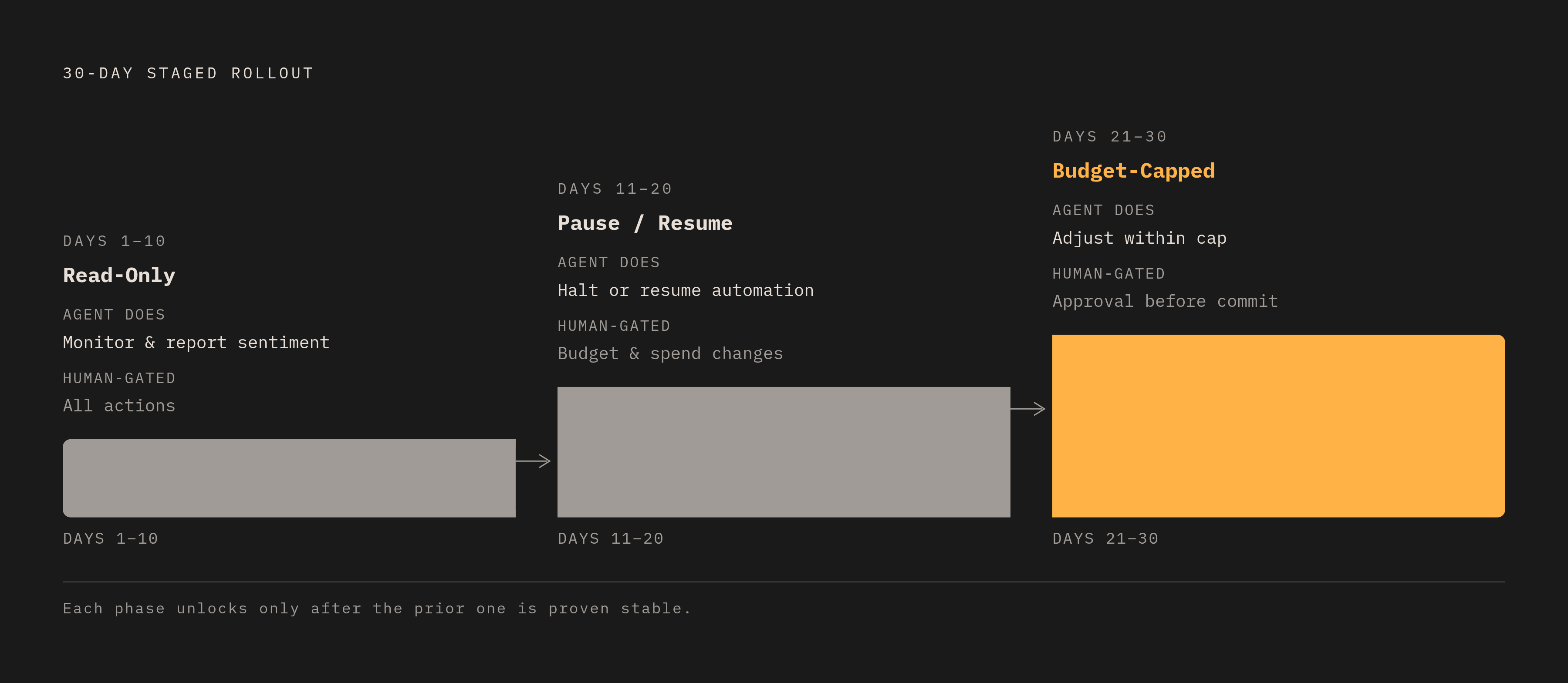
The recommended 30-day rollout starts in read-only mode to monitor and report on sentiment. It then adds pause/resume automation with logging, followed by budget-capped adjustments with human approval. Teams should review activity logs every week before letting the agent do more on its own. This order gives the team time to check the signals and decisions before letting the agent make more kinds of changes to live campaigns.
Every new piece from Comment Section Ads, as it's published.
Follow