AI Agent Workflows That Automate Campaign Launches
A five-stage launch chain, from research to go-live, with human limits.

Meta Ads MCP connects an AI assistant to social media ad accounts through Meta’s official, OAuth-gated server, with read and write access. AI agent workflows that automate campaign launches use that connection to execute a chain of handoffs. A working launch connects research, briefs, creative, targeting, and go-live under human-set limits.
Why campaign launches still require manual stitching in 2026, despite available AI
Most teams with AI tools for paid media still launch campaigns manually because the tools do not form a connected workflow. Research yields findings, creative tools make assets, and someone moves those results into campaign setup. Each link needs an output the next link can use without someone translating it.
That gap also explains why not every team needs an agent. Rule-based automation follows a script a human designed, while an agent designs an approach around an objective and acts on it. Five campaigns that stay much the same per quarter may need only automation. Dozens to hundreds of personalized micro-campaigns, per-customer creative variants, or decisions that must change within hours of launch create a different workload. Those are signs that the work needs an agent, provided the handoffs are ready.
How do you connect your Meta advertising account to an AI assistant using MCP?
Meta shipped its official first-party Meta Ads MCP plus CLI on April 29, 2026. Its server gives an AI assistant OAuth-gated read and write access to the ad account. But access alone is not a launch workflow. The assistant still needs connected tools and permission boundaries for the work it will perform.
The Model Context Protocol gives an agent a standard way to call tools exposed by a server, rather than requiring a separate custom integration for every platform. An agent can call get_campaign_performance, analyze the result, then call adjust_bid_strategy within one reasoning loop where those functions are available. An insight tool, a recommendation tool, and a live-account operator are not interchangeable.
Platform support has spread quickly, but its depth varies. Google released an open-source, read-only Ads API server on October 7, 2025, and announced fully managed MCP support on December 10, 2025. Amazon opened its MCP beta on February 2, 2026, while TikTok launched its Ads MCP server on May 13, 2026. X also launched a server for campaign data, analytics, and ad management. Across connected servers, agents can replace browser-tab switching with tool calls, but write access makes approval workflows, spend caps, and audit trails non-negotiable.
Stage one of the launch chain — market and competitor research
Research comes before creative because it supplies the signal for every later decision. An agent can read the Meta Ad Library, cluster ads running in a niche, and surface patterns as testable angles. Long-running ads provide a public proxy for what may be working. Work that takes a human an afternoon each week can run continuously through an agent. Adside, an end-to-end AI ad platform that keeps competitor research and campaign operations on Google, Meta, LinkedIn, Reddit, and Twitter in one place, is one example.
Competitor monitoring adds context through hooks, offers, CTAs, messaging patterns, share of voice, and channel activity. AdClarity from BIScience covers social, display, video, connected TV, and linear TV, with an entry price of $129/month. Benly tracks ads on Meta, TikTok, Google, and LinkedIn and sends alerts when competitors launch campaigns or change their strategies. Those tools illustrate the research layer’s range. For an agentic launch, the decisive question is whether findings become inputs to campaign creation or stop at a screen someone must read.
Stage two — turning research output into a campaign brief an agent can act on
A brief turns market signals into instructions the agent can execute. It must contain the objective, explicit budget, channel and frequency constraints, audience parameters, research-derived creative direction, and brand guardrails. Vague direction is not harmless at this stage. An agent given only an objective and a budget can generate ads and select audiences while optimizing for platform rewards independently of the brand’s needs.
Google Ads embeds Gemini in its interface to generate campaign structures from a brief and produce ad copy from natural-language direction. Offer and pricing claims, brand safety requirements, and budget authority need to be locked in the brief, rather than debated separately for every generated ad.
Stage three — creative generation at the volume agentic optimization now demands
Creative production is no longer the central bottleneck, but undifferentiated volume does little for an agent. Meta’s Andromeda delivery system rolled out around the world in October 2025 and uses creative signals to choose which ads to serve. Accounts maintaining a large pool of distinct hooks and formats outperform those recycling a small selection. Varied batches can support learning.
Platform tools can now produce those batches. TikTok Symphony includes Image to Video, Text to Video, AI avatars, AI dubbing, Symphony Agent, and Automation for platform-native creative. Canva Grow 2.0 launched June 25, 2026 at Cannes Lions, joining ad creation, cross-platform publishing, and AI optimization. It brings generation, tagging, launch, performance reading, and iteration into one workflow.
Canva’s AI Ad Tagging labels ads by theme, format, message, and creative element so results can be read by attribute. That makes the next batch more informed. The agent can generate from the brief and brand kit, tag each asset, launch, read attribute-level performance, and iterate from what works. Human-approved claims, brand safety and AI-disclosure rules, and budget authority still bound that loop.
Stage four — audience targeting and campaign structure built by the agent
The agent next uses the brief to set up targeting and campaign settings for each platform. It selects placements and match types where applicable, groups ad sets, chooses campaign-budget or ad-set-budget structures, and configures bidding around the objective. The resulting campaign architecture connects the creative pool to the people, channels, and spending rules specified upstream.
Meta CEO Mark Zuckerberg has described a vision in which businesses connect their objective and bank account while Meta’s AI chooses creative, audiences, and placements and decides how to split the budget. That vision shows how broad the agent’s role can become. It does not remove the need for boundaries. CRM audience syncing, frequency caps, and geographic constraints should be locked to the brief. Otherwise, tactical freedom can change who the campaign was authorized to reach.
Stage five — trafficking and go-live — what automated campaign launch actually executes
Trafficking moves structured campaign data into the live platform through authenticated API connections. The agent sends creative assets, targeting parameters, bid strategies, and budget allocations. This is where unresolved handoffs become operational problems. Meta made it easier to qualify for its Marketing API Access Tier and get third-party write access, but agents still need approval workflows and rollback before they can safely act on that access.
The practical deployment sequence begins with read-only observation. The agent surfaces recommendations, while a human approves and executes changes so its judgments can be compared with a buyer’s. A spend cap at half of normal limits exposure during that test. In the next phase, the agent can control budget pacing inside CBOs while it follows the 20% rule and humans still handle creative actions.
Full autonomy comes after those narrower phases. The agent can prune fatiguing ads when frequency crosses a high threshold and CTR drops from its peak, duplicate winners, and regenerate concepts for paused ads. Round-the-clock operation then has a defined scope. Synter Media logs every action with a natural-language explanation and provides instant rollback, illustrating the accountability needed for live-account execution. Omneky’s Approve & Launch feature and Campaign Launcher illustrate the launch gate, with campaign assembly handled by the agent but go-live requiring explicit approval.
Where human checkpoints belong in the chain, and why removing them breaks launches
Human checkpoints belong at decisions that an optimizer has no authority to settle. Offer and pricing claims are the first. An agent cannot establish that a discount, price, or availability claim is accurate and legally compliant, so a human must lock those claims at the brief stage. Brand safety and AI-disclosure compliance form the second gate, with the creative envelope approved before generation expands. These decisions set what the agent may produce so reviewers can avoid having to fix unsuitable output afterward.
Budget authority is the third gate, and it needs enforceable limits. A daily account spend cap and a per-ad spend cap must be in place before the agent touches a budget. A human notification threshold adds oversight within those limits. A ROAS or MER floor blocks scaling on losers, while attribution windows set before launch establish how performance will be judged. These rules let the agent make buying decisions without a person having to approve every change.
The agent owns daily tactics such as pruning fatigued ads, scaling winners, and reallocating budgets within its authority. Humans own direction, the offer, brand constraints, and the performance floor. Collapsing those roles lets optimization outrun the business’s intent. A campaign can pursue a platform objective aggressively while violating the conditions that made the campaign worth running.
The checkpoints also need to match the operating pace. Early engagement signals now receive more weight in platform ranking systems, and weak combinations can be deprioritized within days. Reading results has become a daily discipline. If humans still review only once a week, they can hold up a chain whose other links are connected. Standing rules need to be settled in advance, and the remaining approval gates need to stay reachable at the pace the campaign operates.
What a fully assembled agentic launch chain looks like from brief to live account
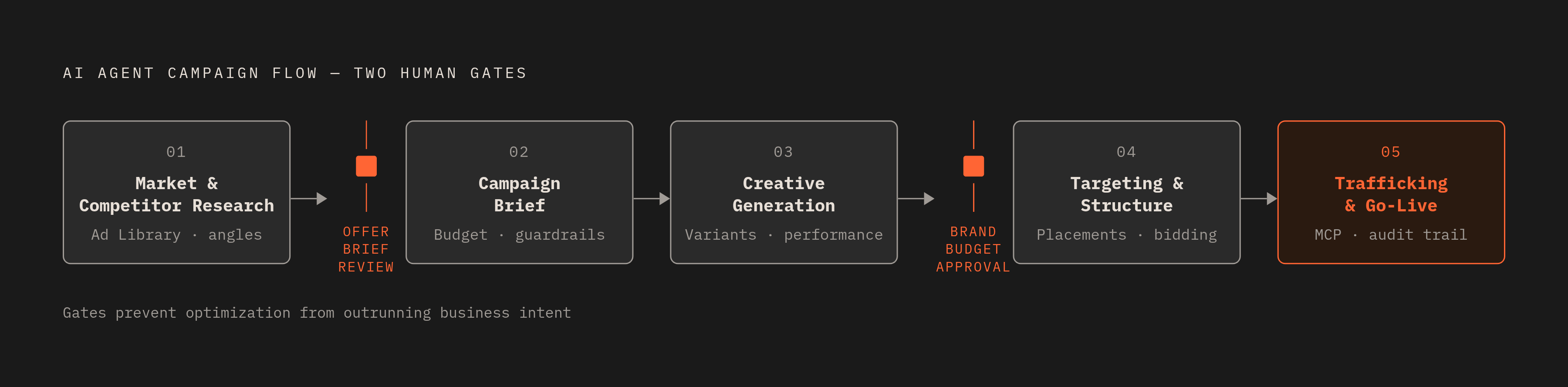
When the workflow is connected, research ends with structured inputs for the brief. The team locks the offer, brand constraints, and budget authority, and the agent turns that governed brief into campaign structure. Creative generation then produces tagged variants from the brief and brand kit. Each output has a defined next destination. Targeting and bidding use the same authorized parameters, producing a configured campaign ready for approval.
After approval, authenticated MCP connections let the agent traffic the campaign through platform APIs and begin initial pacing with an audit trail. Performance then feeds the next creative batch through attribute-level reads, pruning, and governed scaling. The chain returns evidence to generation after launch without restarting from a blank page or asking a person to reconstruct what worked.
A single system can pass those outputs straight from one stage to the next without people having to translate them or cross integration boundaries where work can slow down or fail. But a familiar interface is not evidence of execution. The architectural test remains whether the system recommends or acts, and whether its actions are visible and reversible. A missing answer identifies the link that still needs work before the agent takes control.
Every new piece from Comment Section Ads, as it's published.
FollowMore from Comment Section Ads
- What Claude and ChatGPT Can Control in Facebook Ads When Comment Signals Drive the Instructions9 min read →
- Wiring Your Meta Ad Account to an AI Assistant so It Can Act on Comment Section Signals9 min read →
- Meta Ads MCP Servers That React to Comment Section Sentiment When Optimizing Campaigns8 min read →