What Claude and ChatGPT Can Control in Facebook Ads When Comment Signals Drive the Instructions
Comment signals can steer ad changes only if you route them.

Meta Ads MCP gives Claude and ChatGPT authenticated read-write access to Facebook and Instagram ad accounts through Meta’s official server. Comment signals can guide budget changes, audience updates, and creative swaps, but only when someone routes those signals into the agent’s instructions. The connection grants tools, and advertisers need to distinguish what those tools support from what permissions, approval gates, and Meta’s internal systems allow.
What does Meta's official MCP server give AI agents access to?
Meta’s official MCP server exposes the Marketing API through a standard interface that AI clients can use. MCP stands for Model Context Protocol, an open standard originally developed by Anthropic and later donated to the Agentic AI Foundation, a directed fund under the Linux Foundation. It lets compatible clients call a defined set of tools. The model interprets an instruction, while the server provides the authenticated route into the ad account.
Before April 2026, running an AI agent on Meta ads required a custom Marketing API wrapper, with token rotation, app review, and developer-app provisioning. The official server reduces that connection to a one-time OAuth flow, without developer credentials for the MCP path. Meta names ChatGPT, Claude, Claude Code, and Perplexity as supported agents. Because the protocol is open, other MCP-compatible clients can connect too.
Write access distinguished Meta’s launch from comparable servers that started read-only. Agents could create and edit account objects from day one. That distinction makes the connector useful and consequential. It does not, however, mean every proposed change can go live without approval, or that every part of Meta’s advertising system is exposed.
The seven tool categories and 91 tools that define the agent's functional range
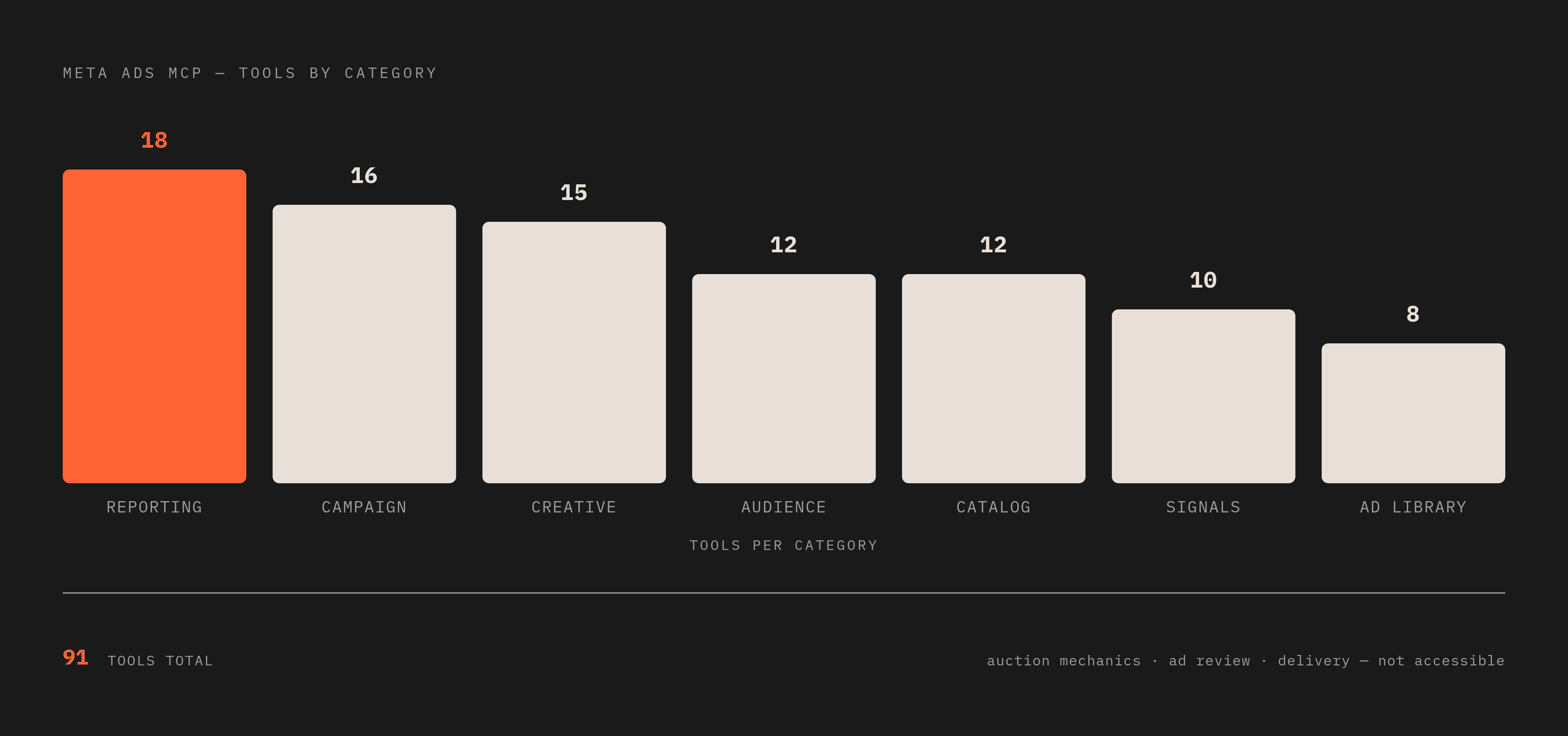
These categories define the agent’s working range. They cover both reading account conditions and changing supported objects, but they do not give the agent control over the platform itself.
Reporting includes spend, ROAS, CPA, CPM, CTR, frequency, and conversions, with breakdowns by age, geography, and placement. It also includes opportunity score, anomaly signals, trends, and industry benchmarks. On the campaign side, agents can create, pause, duplicate, edit budgets, adjust schedules, and switch optimization goals through natural-language instructions. With audience tools, agents can create, update, and delete custom audiences, including lookalikes. Permission to “improve performance” must be defined through these separate controls.
With catalog tools, agents can check product sets, fix feed errors, edit items, and run diagnostics for Advantage+ catalog ads. Signal tools cover pixel event rules and parameters, dataset statistics, Event Match Quality scores, and deduplication diagnostics. Creative support includes single-image, single-video, carousel, and catalog-carousel ads, plus asset uploads to the account library. Meta’s tool reference also includes ads_library_search for public Meta Ad Library research. Every agent action appears in the account activity log under the connected user, which makes changes traceable but does not establish that they were sound decisions.
How comment signals enter the architecture as an instruction layer on top of MCP access
Comment signals do not enter this toolset automatically. The server does not listen to ad comments. A practitioner must choose to send engagement data from comment-automation tooling into the agent’s prompt context or structured instructions. The comment layer gives the agent evidence and triggers, while the MCP layer gives it access to the account. Mixing up those roles can make it seem as though connecting Claude or ChatGPT starts a campaign manager that is always on and acts on comments.
A comment-automation layer can capture keyword responses to an offer such as “comment SIZE and we'll send the link.” Question-detection logic can also recognize buying vocabulary about price, stock, or shipping and open a DM without the buyer using the requested keyword. That second route is important because most intent on a live ad post arrives as freeform questions. Tools in this category route those signals into Messenger or CRM data. A human or automation layer must then translate the enriched data into instructions the agent can use.
Meta announced in October 2025 that text and voice conversations with Meta AI would inform content and ad selection on Facebook and Instagram from December 16, 2025, without an opt-out for Meta AI users. That is platform-side targeting, separate from a comment feed supplied to Claude or ChatGPT. An advertiser’s comment-to-agent pipeline uses engagement data that someone has chosen to route to the agent to ask for account changes the tools support. It can lead to reporting and execution, but only after that connection has been built.
What comment-driven instructions can genuinely control: budget shifts, audience actions, and creative swaps
An agent can adjust daily or lifetime budgets across campaigns and ad sets when routed comment signals suggest stronger buying intent. The number of high-intent comments on an ad might therefore guide an increase in its ad set’s budget. This can move real spend when permissions allow. The often-used rule of increasing a winning campaign’s budget by no more than 20% every 72 hours per campaign is a recommended heuristic that can be overridden.
Audience changes use a different part of the toolset. Commenter behavior routed through a CRM can inform custom-audience creation or updates, while high-intent cohorts can inform changes to lookalike sources. Agents can also pause ad sets accumulating low-quality engagement signals. The distinction is between engagement and useful engagement. A busy comment section alone does not show that spending more on an audience would be worthwhile.
With creative controls, the agent can pause ads that get many comments but have weak conversion signals, duplicate and activate variants where approval rules allow, and upload replacement assets. Supported formats include single-image, video, and carousel creatives. The comment signal selects a reason to act. It does not expand the available creative tools.
For a concrete example, price questions on a brand-awareness ad can suggest a mismatch between the creative and the audience’s stage. Routed into the agent’s context, that pattern could support an instruction to switch the ad set’s optimization goal or prepare a more suitable creative variant. Performance gains from this possible workflow remain uncertain. Its credibility comes from matching the proposed action to tools the server actually exposes.
What comment-driven instructions cannot control: the structural and platform-enforced boundaries
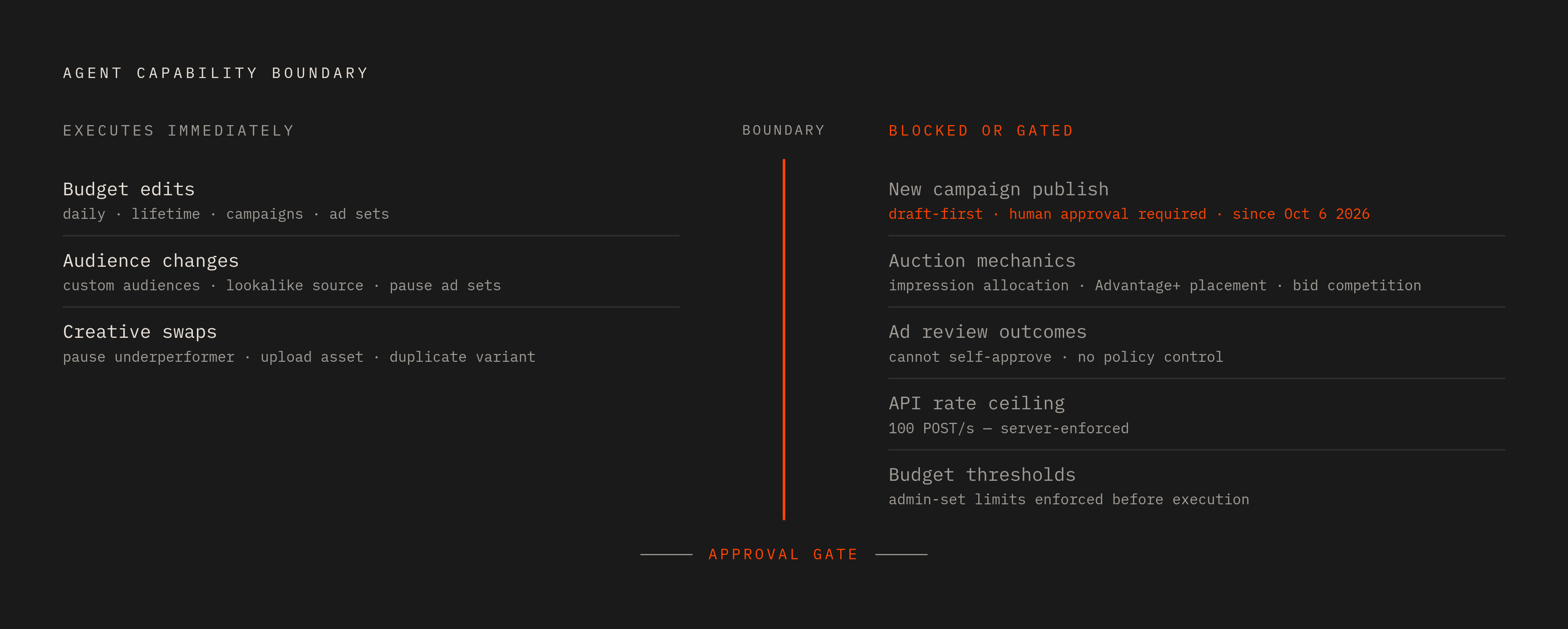
The connector is reactive, not continuous. It runs when a prompt is submitted and does not watch an account in the background. If creative fatigue starts at 11 p.m. on a Friday, the agent discovers it at the next query unless a separate monitoring layer supplies an instruction. Understanding a signal better cannot make the agent act without a trigger.
Publication introduces a separate, enforced boundary. Meta’s October 6, 2026 update at Advertising Week New York made campaign work created by an agent draft-first in Ads Manager, with permissions set by the advertiser and explicit approval needed before it could be published. The agent stages new campaign work, and the human publishes it. Broader agentic assistant actions inside Ads Manager were still beginning to be tested. That checkpoint is not universal, however, because permitted budget edits and audience changes can execute immediately.
Auction mechanics are structurally outside the agent’s reach. It cannot tell Meta how to allocate impressions within an auction, override Advantage+ placement decisions, or change how bids compete. Nor can it approve its own ads or control review outcomes. Generated or modified creative still enters standard review and can be rejected. Account editing is not authority over delivery or policy enforcement.
Since June 2026, ads significantly edited or created with Meta’s built-in generative tools, or third-party AI tools embedding C2PA metadata, automatically receive an “AI info” label. For photorealistic AI-generated people, that label can appear next to the “Sponsored” tag. The agent cannot suppress it.
API and administrator restrictions constrain execution further. Meta Marketing API allows no more than 100 POST calls per second for write operations, whether the requests come through MCP, the CLI, or custom code. A broad instruction can lead to many calls, each for an ad set, creative, or audience. Since July 16, 2026, business portfolio admins can also block specific agent actions per ad account, including campaign creation or budget editing, and set budget-change thresholds. Those rules are enforced server-side before the instruction executes, unlike an overridable budget-growth heuristic.
The governance risk that sits between the permitted and the forbidden
A permitted action can still be part of a risky workflow. At launch, the connector requested broad OAuth access and offered no read-only mode in the initial beta beyond restrictions imposed by admin rules. An agent with permission could pause campaigns, change budgets, and edit creatives. That makes the quality of the instructions consequential. Technical access does not establish that the agent has enough evidence to use it well.
Francis Teo’s LinkedIn response to Meta’s April announcement argued that the connectors were “absolutely worthless unless Meta addresses the concerns officially and clearly that people are getting banned for using automation solutions”. Meta’s Business Help Center offered a narrower reassurance in guidance dated October 31, 2026. It states, “It's safe to connect your ad account through Meta's ads MCP server, and it's unlikely that an account would be banned simply for using it”. The distinction is in “simply for using it”. Connection is not a blanket exemption for every workflow built on top.
Unsupervised writes, missing call pacing, and immediate retries after every error can produce patterns Meta’s systems treat as abusive even when individual operations are permitted. The official connection still has rate limits and abuse controls. Nor does it check whether every piece of ad copy respects a brand’s rules before a write. Fast execution can multiply policy problems when that check is absent.
Brand guardrails belong before each write operation, with human checkpoints retained where the workflow requires judgment. Call pacing and controlled error handling address a different risk from content review. Both are necessary parts of governance. Draft-first campaign creation reduces unilateral publishing, but it does not protect every immediately executable budget or audience change. An activity log helps trace those actions after they happen, but cannot stop them beforehand.
How a unified platform with continuous monitoring changes the boundary conditions
Continuous monitoring changes when an agent can respond. A layer that watches signals and supplies instructions can address overnight or weekend activity without waiting for an analyst’s next chat session. This is a different architecture from the connector alone. It does not remove Meta’s permissions, approval gates, or delivery restrictions. Instead, it fills the gap between a new signal and an authorized response.
A broader platform can also change the scope of the decision. Meta comment signals sit beside campaign data from Google, LinkedIn, Reddit, and X, while a Meta-only connector cannot operate across that full picture. With those channels in one interface, teams can weigh cross-channel budget decisions and check whether incremental conversions have been double-counted. Competitor research adds another kind of context. Creative changes, new offers, and launch timing can inform decisions in ways comments on an advertiser’s own posts cannot.
For teams that do not want to assemble the comment-to-agent pipeline by hand, Adside is one single-interface option, combining competitor ad research, creative automation, and campaign execution for Meta and four other networks. Adside remains subject to Meta’s controls.
The architectural requirement is therefore specific. Signals need continuous monitoring, proposed actions need preset rules, and brand checks and human approvals need to sit inside the workflow before execution. Cross-channel context can help teams decide where to spend, but it cannot override the budget restrictions enforced on an account. Advertisers need to establish what an agent can change, which evidence permits a change, when approval is required, and what stops the agent before an allowed action becomes an expensive mistake.
Every new piece from Comment Section Ads, as it's published.
Follow