MCP vs Native AI Features in Ad Platforms
Native AI runs the auction, while MCP only lets agents operate the account.
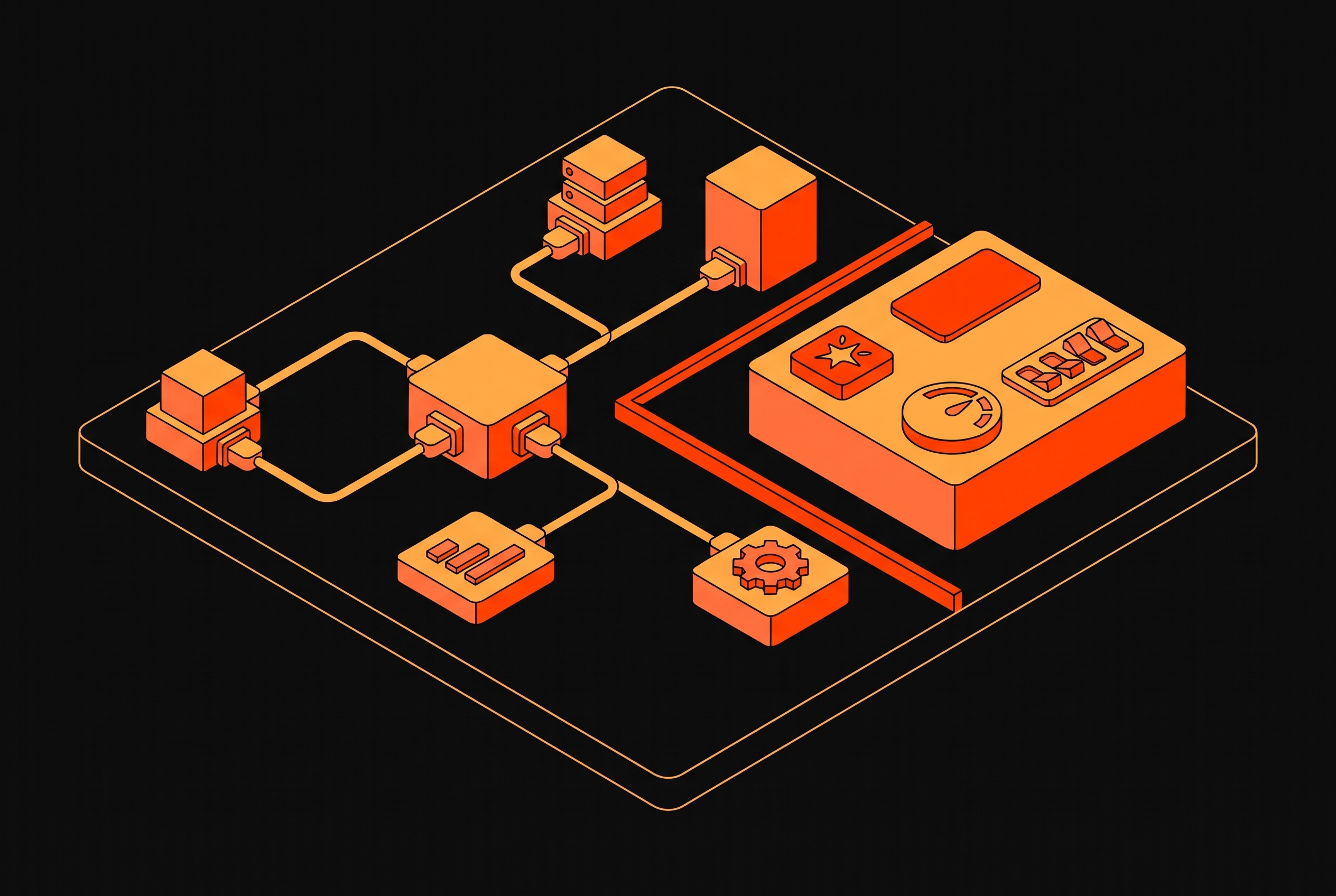
Meta Ads MCP connects an AI assistant to a Meta advertising account through tools that read data and make changes to the account. Meta’s official server supports both, and the objects it creates stay paused until a human approves them. This is not a replacement for native AI such as Meta Advantage+. Native AI controls auction and delivery decisions, while MCP controls how an outside agent works with the account.
What native AI and MCP actually are, and why conflating them causes real problems
A marketer who tries to “add MCP” to improve bidding is asking an account connection to do the auction engine’s job. A marketer who expects Performance Max to report across platforms makes the opposite mistake. These mistakes leave either an agent expected to control decisions it cannot reach or a platform feature expected to coordinate accounts it cannot see.
The confusion starts with the label “AI”. Google’s Smart Bidding, Performance Max, Meta Advantage+, and LinkedIn Accelerate all work inside the systems their platforms use to make decisions. They are not outside tools an advertiser installs to supervise the auction. MCP, by contrast, gives an outside assistant a way to interact with an account.
That distinction sets the limits of any useful comparison. A native feature’s ability to optimize delivery says nothing about whether an assistant can retrieve a report or pause a campaign. An MCP server that can change an account still has no access to the platform’s internal audience signals. These are separate questions with separate answers. Treating them as one feature category hides both the useful capabilities and the missing ones.
What native AI actually controls: the auction, the targeting, the delivery
Native platform AI works inside the platform’s own systems. It governs real-time bid adjustments, audience signal interpretation, creative delivery sequencing, and budget pacing. These decisions happen within a single advertising ecosystem, using information available to that platform. An external tool cannot replicate or override that internal decision process. Changing a campaign setting is not the same as taking over the machinery that serves it.
The distinction is especially clear with bidding. An advertiser or agent can make an account-level bid change where the available tools allow it, while native AI still handles the platform’s internal decisions. The two actions sit at different levels. The same holds for creative delivery, where choosing or uploading an asset does not control every later decision about how to serve it. Native AI decides how to use the available inputs within the platform.
That reach ends at the platform’s boundary. A campaign running under Google’s Smart Bidding has no visibility into, or effect on, activity in a Meta account. Even when both accounts use AI, its optimization remains limited in scope to its own platform. Smart Bidding, Performance Max, Advantage+, and Accelerate all have that limit, even though they are different products.
For straightforward, single-platform campaigns, that boundary may be entirely acceptable. Native features provide substantial automation without an additional tool charge because they are the platform operating as designed. There is no marginal tool expense for this layer. An advertiser whose needs stay within it does not need an external connection merely to make the campaign “AI-powered”. The automation is already inside the platform.
What MCP actually controls: the interface between an AI agent and the account
Anthropic created Model Context Protocol in November 2024 as an open standard for connecting AI assistants to outside systems. Its standardization benefit resembles USB-C giving hardware a universal connector. The connection follows a common pattern rather than requiring the assistant to handle every platform differently. But a common connector does not make every connected system equally capable. What the agent can do still depends on the tools the server exposes.
MCP uses a client-server architecture. The client lives inside Claude, ChatGPT, Gemini, or another compatible host, while the server wraps the ad platform’s API and presents its capabilities as named tools. The agent can discover and invoke those tools. The server handles platform-specific work such as OAuth token management, API versioning, rate-limit backoff, and field validation. That division lets the agent focus its reasoning on advertising decisions.
For Meta advertising, the official server is available at mcp.facebook.com/ads. Connecting through MCP means using a compatible assistant as the client and the Meta server as the account-facing connection. The operational questions are which account capabilities the server exposes and whether those capabilities permit changes.
Once connected, tools can form a sequence. An agent can retrieve performance data, reason about the results, and call a bid-adjustment tool within the same reasoning loop if that tool is available. MCP provides structured, auditable access, but it does not touch the auction itself. Pausing a campaign through MCP does what a human would do in the interface, while native AI keeps serving ads with the budget left until the pause takes effect. MCP is the control surface, and native AI is the engine.
Why write access is the divide that actually determines operational usefulness
A read-only server confines an agent to reporting and recommendations. A write-capable server can let it execute the work it proposes. “Has an official MCP server” is therefore incomplete information for a buyer. A useful comparison covers what is needed for access, which write operations are available, and who must approve those operations.
Meta launched its official server in open beta on April 29, 2026, with read and write support from day one. Its 29 tools span campaign management, catalog operations, reporting, diagnostics, and accounts, pages, and assets. Every created object lands in a paused state pending human approval. That safeguard separates creation from live spending. The locally installed Meta CLI, a companion to the server, also creates campaigns paused by default, so the paused-creation protection is not unique to MCP.
Amazon Ads entered open beta on February 2, 2026, with tools to create, update, and delete campaigns, run reports, and manage billing data. Its Sponsored Products workflow can assemble a full campaign from a single prompt. Access still has a credential requirement. It is limited to those with active Amazon Ads API credentials, including Amazon Ads partners and direct advertisers who apply. TikTok provides another read/write option through its TikTok for Business MCP server, shipped on May 13, 2026, and its Agentic Hub, launched on June 30, 2026, covering campaign management, performance reporting, audience configuration, and creative operations.
Google presents a less straightforward access picture. Google’s official documentation describes its server as deliberately read-only, without bid modification, campaign pausing, or new asset creation. Its GitHub README, however, includes four write tools named create_asset, upload_video_asset, manage_labels, and manage_label_associations. Each uses a two-step confirm-with-checksum workflow. Those tools do not give an agent write access to campaigns as a whole. Google sunset developer tokens on September 9, 2026, so they no longer determine API access levels, and tokens sent in headers are accepted but ignored, with active rejection deferred to a future major API version.
Microsoft Advertising launched an open pilot with read-only access and self-serve onboarding through Azure app registration, without a waitlist. Pinterest entered an alpha partner program with read-oriented access. Snapchat announced MCP intent on June 18, 2026, covering planning, creation, and optimization, but without a public tool catalog or self-serve setup. Its actual server launched read-only on August 3, 2026, with writes planned for a future release.
What the two layers can and cannot do when combined across channels
Running native AI and MCP-connected agents together is not duplicate automation. Native AI handles optimization within each platform, while an agent can bring together reports and decisions about accounts across the platforms it connects to. Each layer supplies something the other lacks. The agent can reason across accounts without becoming the auction engine for any of them. Native AI can continue optimizing delivery without gaining a view of the wider advertising plan.
The available connections determine how far that coordination goes. Read access can support reporting synthesis across accounts, but an agent cannot execute a proposed change through a server that exposes no suitable write tool. A workflow across those accounts can carry out some changes and only advise on others. For example, Meta’s read/write access and Microsoft’s read-only launch support different kinds of participation. Calling both “MCP-enabled” would conceal the distinction at the point where a recommendation needs to become an action.
That gap is significant because LinkedIn CPCs are among the highest in paid advertising. AI-driven audience expansion can use up budget quickly unless someone watches it closely. Both native AI and an MCP-connected agent still need rules for human review to guard against that risk.
Reporting access establishes what an agent can inspect, write tools establish what it can change, and human review rules establish which consequential decisions it should not make alone. Those distinctions still matter when several accounts share one interface. The combined system is useful only within the access and review boundaries that actually exist.
Where native AI genuinely wins and where MCP-connected agents add distinct value
Native AI earns its place through access to real-time auction dynamics, first-party audience data, and engagement signals used to sequence creative delivery. Those are advantages of its position inside the platform. An MCP connection does not transfer those signals to an external agent. The right division of work leaves internal delivery decisions with the system that can see the information behind them.
Meta Advantage+ Creative illustrates how far native features already reach. It handles image variations, headline rewrites, music selection, background generation, and basic image-to-video, with advertiser adoption growing sharply over recent quarters. But those capabilities still have a defined workflow. Native creative tools need someone to upload assets and choose from a limited set of variations. A “product URL in, 30 distinct creatives out” workflow does not exist natively on any platform.
MCP-connected agents add distinct value where the work extends beyond those limits. Their roles include cross-platform reporting and coordination, creative generation workflows beyond native tools, and audience and competitive intelligence the platform does not surface. They also support controllable account-level workflows such as budget reallocation, bid rule enforcement, and anomaly response. MCP supplies the connection, the agent’s wider workflow provides creative generation and intelligence, and the server controls what the agent can do in the account.
That wider reach also makes governance unavoidable. Ad accounts are high-stakes environments where an incorrect automated action can cost money immediately, and an agent can confidently propose a change without enough business context. A sound way to work keeps humans in charge of decisions with serious consequences, including campaign launches and budget changes above a threshold. Agents can take on more of the lower-stakes work and do it quickly. A server’s write permission establishes technical ability alone.
The choice is therefore not native AI or MCP. It is which layer owns each decision, given the signals, tools, and approvals available. Understanding that boundary is the prerequisite for using either effectively.
Every new piece from Comment Section Ads, as it's published.
FollowMore from Comment Section Ads
- Meta Ads MCP Servers That React to Comment Section Sentiment When Optimizing Campaigns8 min read →
- Wiring Your Meta Ad Account to an AI Assistant so It Can Act on Comment Section Signals9 min read →
- Routing Meta Ads Budget Decisions Through Comment Section Signals Instead of Impression and ROAS Alone8 min read →